Asia is the fastest-growing market for customer support chatbots in the world. According to Mordor Intelligence's 2026 chatbot market report, the Asia-Pacific region is expanding at a 24.71% compound annual growth rate through 2031, faster than any other region globally. Small businesses are driving much of that growth. Industry data from Fullview shows 64% of small businesses plan to adopt chatbots by the end of 2026.
The demand is real. The tools most small business owners find when they search are not.
Every major chatbot guide recommends the same names: ManyChat, Tidio, Intercom, Zendesk, Chatfuel. These are genuinely capable products. But they were designed for a specific kind of business in a specific kind of market. That business has a website, a CRM, a support team, a USD budget, and customers who write in English. Most small businesses across Asia have none of these things. The result is a structural mismatch that no amount of tutorials or free trials can fix.
Here is exactly where the mismatch happens.
The pricing is calibrated for Western markets
ManyChat's entry plan starts at $15 per month for 500 contacts. That sounds affordable until you understand the model. ManyChat charges per active contact, meaning the more your audience grows, the more you pay. A promotional post that spikes your contact count from 500 to 2,500 pushes your monthly bill from $15 to $29, without warning.
Tidio's real cost for a small business once you add the Lyro AI add-on lands at $68 to $150 per month, according to Docuyond's 2026 chatbot pricing analysis. Intercom charges per resolution. Zendesk starts at $55 per agent per month, which for a five-person team means a minimum of $825 monthly.
These numbers are reasonable for a UK or US small business with monthly revenue in the thousands of dollars. They are not reasonable for a solo clothing seller in Dhaka, a home service provider in Manila, or a food delivery business in Jakarta. The tools were priced for one market and quietly exported to another.
They are built on flows, not conversations
ManyChat, Chatfuel, and most major platforms are flow-based tools. You build decision trees. The customer says X and the bot says Y. The customer says A and the bot says B. This works when customers type predictable things in a predictable sequence.
Asian customers do not. A developer writing about real chatbot deployments documented this failure precisely: an education platform built a careful enrollment flow, then real users arrived and sent everything at once: course interest, schedule preferences, refund policy questions, and payment options, in a single message. The bot handled one answer at a time and got stuck. Enrollment through the bot was 12%. Through human agents it was 68%.
ManyChat's own reviewers acknowledge this directly. The platform's AI capability is described as a single AI step within a flow, not a free-form conversation. It is, as one 2026 review put it, a bot with an AI sprinkle.
A customer in Bangladesh who types "bhai product ta available? COD hobe? deliver kobe?" is not following a flow. A customer in the Philippines who types "ate, magkano total with shipping? pwede bang COD?" is not following a flow. Neither is a customer in Indonesia, Vietnam, or anywhere else in the region. These tools were built for customers who behave like forms. Asian customers behave like people.
They assume your business lives on a website
Every major tool in the chatbot category defaults to website chat. Tidio's primary use case is a widget on your website. Zendesk builds Messenger bots as an extension of a helpdesk ticketing system. Intercom is designed for SaaS products and their in-app users. Chatbase trains its AI on your website content. The entire category assumes you have a URL.
Across Bangladesh, Philippines, Vietnam, Indonesia, and Cambodia, millions of small businesses do not have websites. Their storefront is a Facebook page. Their checkout counter is Messenger. Hashmeta's 2025 Southeast Asia social media report confirms that many businesses across the region conduct the majority of their customer interactions through Facebook and Messenger rather than email or phone. Cube Asia's analysis of social commerce confirms that Meta's advanced commerce features available in the US have not arrived in Southeast Asia, leaving businesses to rely on Messenger for the full buying journey.
Facebook is not a secondary channel for Asian small businesses. It is the only channel. Tools designed for websites treat it as an afterthought.
Their language support is translation, not understanding
Most major chatbot platforms advertise support for 40 to 95 languages. What they mean is translation. What Asian small businesses need is understanding.
A 2025 investigation by Rest of World into Filipino AI development found that popular large language models trained primarily on English struggle with conversational Filipino and Taglish, the natural mixed-language that 80% of Filipinos use when typing casually. Only 55% of Filipinos speak English fluently, and ChatGPT's responses, while grammatically correct in Filipino, are often not natural enough for a Filipino speaker to understand easily.
The same applies to Bangla. Research from the Islamic University of Technology on Bangla conversational agents confirms that existing chatbot systems provide insufficient support for low-resource languages like Bangla, particularly Bangla transliteration in English, the way most BD customers actually type. "Price koto bhai?" is not English. It is not Bangla. It is Banglish, and a tool that can translate one of those languages cannot handle the other.
The Alibaba seller blog for Southeast Asia states this directly from real deployments: cultural nuance matters more than translation accuracy. A bot that translates is not a bot that understands.
They require setup knowledge most Asian small business owners do not have
Every tool on the major lists markets itself as no-code. In practice, no-code means no programming language required, not no technical knowledge required. Building a ManyChat flow still requires understanding branching logic, conditional responses, audience segmentation, and integrations with third-party tools. Setting up Tidio with its full AI capabilities requires connecting multiple add-ons, configuring conversation routing, and managing a knowledge base structure.
For a salon owner in Dhaka, a repair service provider in Cebu, or a food seller in Hanoi managing their business alone on a smartphone, this is not a setup challenge. It is a barrier.
The tools assume a marketing team or at minimum a tech-comfortable founder. The businesses that need automation most are the ones with the least capacity to configure it.
What actually works for small businesses in Asia
The structural gaps above are not minor product limitations. They are design decisions made for a different market. Closing them requires a tool built from the ground up for this context, not retrofitted for it.
What that tool needs to do:
It needs to reply through Facebook Messenger as the primary channel, not a secondary one. It needs to understand how customers in this region actually write, in mixed languages, off-script, in single messages that contain five questions at once. It needs pricing that makes sense for a small business earning in local currency. It needs to be live in minutes, not hours, with no flow builder required. And it needs to handle the full customer conversation, from the first inquiry through the order, not just acknowledge the message and pass to a human.
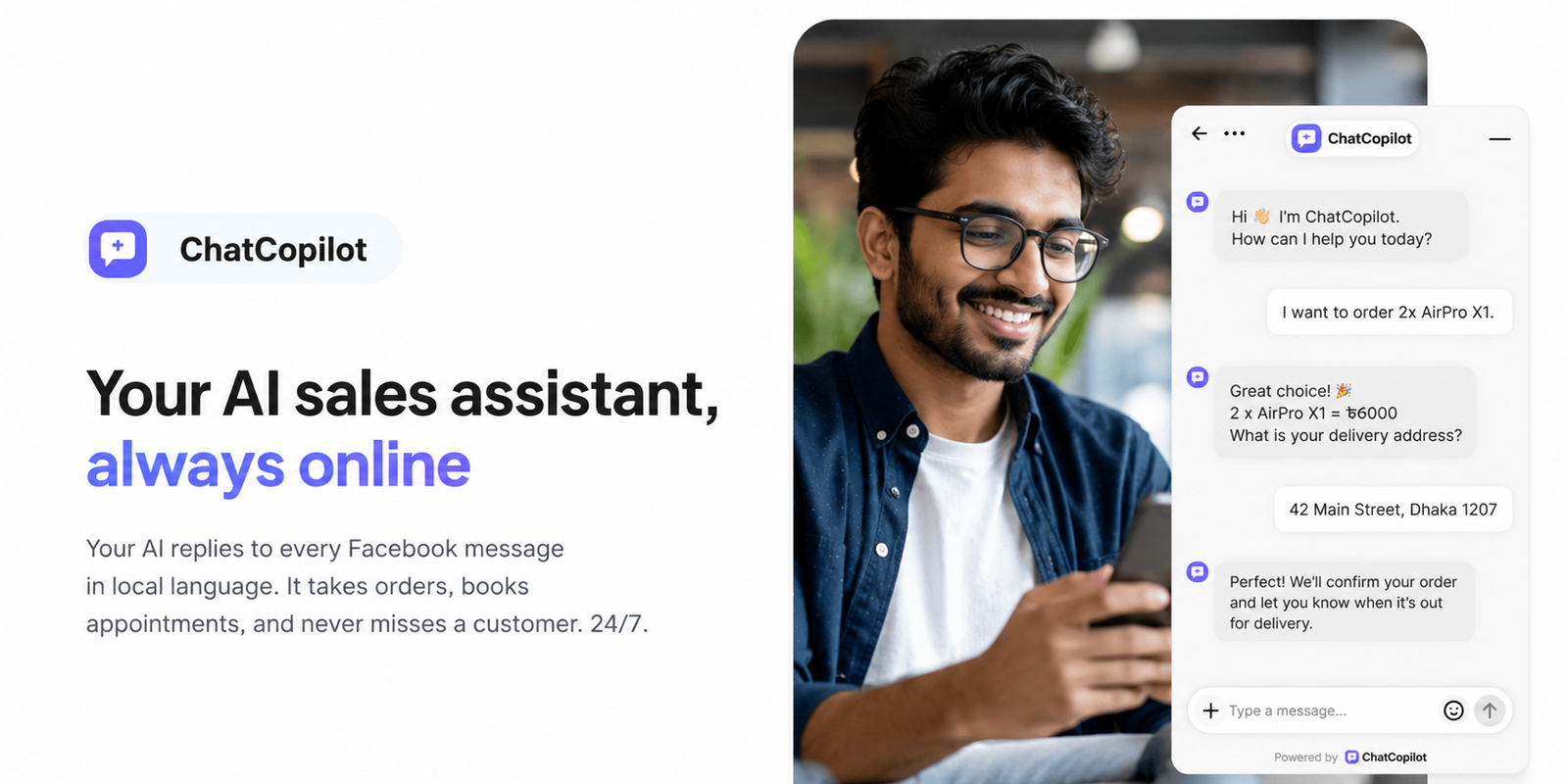
ChatCopilot is built for exactly this. It connects to your Facebook page through an official Meta integration, goes live in under five minutes, and replies through the Messenger API in Bangla, English, Banglish, or any language your customers write in. It reads your product catalog and knowledge base, answers real questions, handles orders and appointments, and does this 24 hours a day. No flow builder. No per-contact pricing surprises. No assumption that you have a website.
The major tools are good products. They are just not built for your market. The difference matters.
ChatCopilot is an AI sales assistant for small businesses on Facebook Messenger. Built for Asia. Goes live in 5 minutes. Try it free during beta.