Bangladesh has over 300,000 Facebook-based shop pages. Most of them are run by one person.
That one person takes the photos. Writes the posts. Packs the orders. And replies to every single Messenger message, manually, one by one.
It works. Until it doesn't.
The inbox is where sales die quietly
When a customer messages your Facebook page, they are ready to buy. They just need a quick answer. Price. Size. Delivery area. Something simple.
But if you are busy, asleep, or on a day off, that message sits there. Unanswered.
HubSpot research shows most social media users expect a reply within one hour. Facebook itself rewards pages that respond within 15 minutes with a "Very Responsive" badge. That badge signals trust. It brings more messages. More sales.
Most small shop owners in Bangladesh cannot hit that standard consistently. Not because they don't want to. Because they are human.
Three moments where the inbox breaks down
1. Late nights and early mornings
F-commerce in Bangladesh does not follow business hours. Customers browse and message after dinner, 9 PM, 11 PM, midnight. That is when your competitor's page, if it has automation, is already replying. Yours is quiet.
By morning, that customer has either bought elsewhere or forgotten they messaged you.
2. Eid, holidays, and days off
Every shop owner deserves a break. But a Facebook page never closes. During Eid, when message volume spikes and you are with your family, your inbox fills up. When you come back, you are replying to 200 messages, most of them now cold.
Managing a human moderator for these periods means training them, trusting them with your page, and paying them. For a solo or two-person operation, that cost does not make sense.
3. High-volume sales days
A viral post. A good offer. A shared reel. Suddenly 150 messages arrive in two hours. A human can realistically handle 20 to 30 conversations at once before quality drops. The rest wait. Some leave.
Scaling a human team to match unpredictable spikes is expensive and slow. By the time you hire and train, the spike is over.
This is not a Bangladesh-only problem
Sellers in the Philippines face the same situation. Facebook Messenger is the number one messaging app in the Philippines, just like it dominates social commerce in Bangladesh.
Filipino online sellers discovered the same pattern: most buyer messages arrive outside work hours, and a slow reply means a lost sale. A 2024 Philippines digital study by DataReportal found that 71% of Filipino SMEs use social media for customer engagement but have no structured system to handle replies at scale.
The difference is that the Philippines now has a growing ecosystem of AI tools built specifically for Facebook page sellers. Products like ChatGenie automate the full flow, inquiry, order, payment, delivery, inside Messenger. Sellers report handling the same volume without adding staff.
Bangladesh is at the same point the Philippines was two or three years ago. The problem is identical. The solution is now available here too.
Why "just hire someone" doesn't work
It sounds simple. Pay a person to watch the inbox.
But a human moderator needs time to learn your products, your prices, your tone. They make mistakes. They go offline. They need days off too. And when your catalog changes, you have to retrain them.
For a shop with 100 SKUs, seasonal pricing, and a mix of Bangla and English customers, consistent human moderation is genuinely hard to maintain at quality.
AI does not replace the human relationship. But it handles the repetitive 80%, price questions, availability checks, delivery areas, order collection, so you or your team can focus on the 20% that actually needs a person.
The language question
Earlier chatbot tools in Bangladesh failed one basic test. They replied in English to customers who wrote in Bangla. Or they broke completely when someone typed "vai eta ki available?" instead of "Is this available?"
That is not a small problem. It is the whole problem. A bot that cannot handle Bangla, Banglish, and the natural way Bangladeshi customers actually type is useless for most f-commerce shops.
This has changed. AI language models today handle mixed-language conversations naturally. A customer can write "color options ki ki ache apu?" and get a relevant, natural reply, without you doing anything.
What this actually looks like in practice
You upload your product catalog or FAQ. The AI reads it. From that point, when a customer messages your page:
- It replies within seconds, day or night
- It answers in whatever language the customer uses
- It collects order details and saves them to your dashboard
- If it cannot answer something, it tells the customer and flags you
You wake up to a dashboard of orders, not a wall of unanswered messages.
The gap is closing fast
The 300,000+ f-commerce pages in Bangladesh represent a massive, largely manual operation. According to The Business Standard, f-commerce accounts for around 80% of total daily e-commerce sales in Bangladesh. That is real money moving through Facebook pages, most of it still handled by hand.
Dhaka Tribune puts the total f-commerce market size at around Tk 1,000 crore, with over 300,000 active pages. The shop owners who automate their inbox first will respond faster, capture more late-night orders, and scale without proportionally growing their team. The ones who wait will keep doing what they are doing, until a competitor on the same platform starts replying in two seconds instead of two hours.
Try it on your page
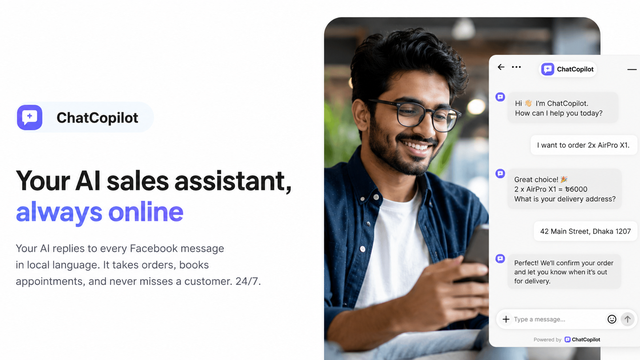
ChatCopilot connects to your Facebook page in under 5 minutes. You upload your products info or FAQ. Your AI goes live, replying in Bangla, English, or Banglish, taking orders, saving everything to your dashboard.
It is free to try during beta. No credit card. No developer needed.